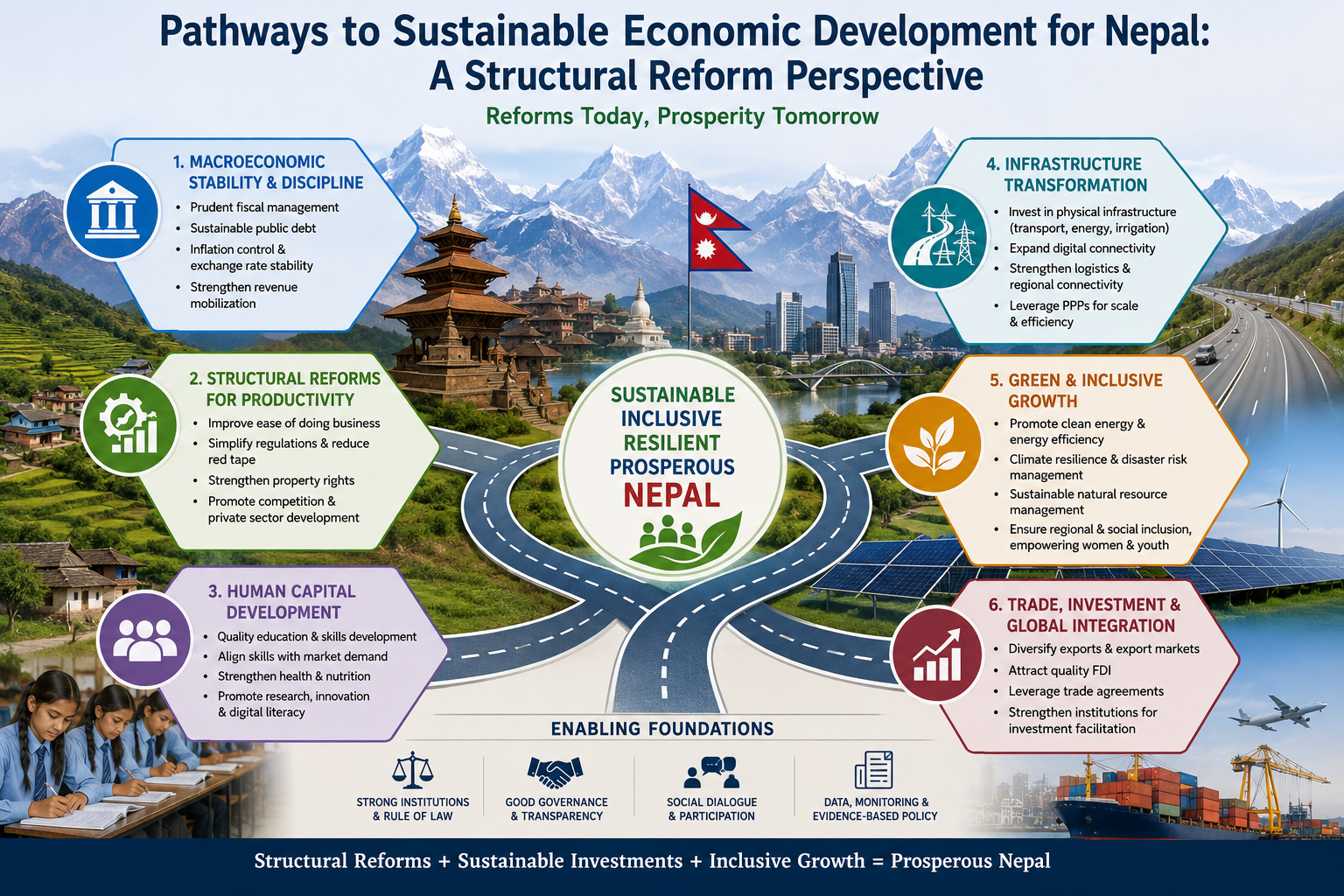
Pathways to Sustainable Economic Development for Nepal: A Structural Reform Perspective
Economic development is fundamentally driven by a country’s ability to increase productive capacity, reduce structural inefficiencies, and integrate strategically into global markets.
-
by Unitedforum
Share on:
Pathways to Sustainable Economic Development for Nepal: A Structural Reform Perspective
Economic development is fundamentally driven by a country’s ability to increase productive capacity, reduce structural inefficiencies, and integrate strategically into global markets. For Nepal, a long-term development strategy must focus on strengthening domestic production, expanding high-value exports, and creating an investment climate that mobilizes private sector dynamism. However, some proposed approaches to economic transformation require careful reconsideration to ensure they are both practical and globally viable.
1. Strengthening Domestic Production and Reducing Import Dependency
Reducing excessive import dependency is a valid development objective. Nepal’s trade imbalance reflects limited industrial capacity and a narrow production base. Strengthening domestic agriculture, light manufacturing, and agro-processing industries can help reduce unnecessary imports while improving rural incomes.
However, complete import restriction or economic isolation from major trading partners is neither realistic nor beneficial. In the case of Nepal–India trade, the economies are deeply interlinked through geography, supply chains, labor mobility, and transit arrangements. A full blockade-style approach would likely disrupt essential goods, increase inflation, and harm domestic consumers and industries. Instead, the more effective strategy is trade diversification, value addition, and competitive import substitution where Nepal has realistic capacity advantages.
2. Export-Led Growth in Emerging Sectors
Nepal’s long-term economic opportunity lies in developing export-oriented sectors with high growth potential. Key areas include:
Information Technology (IT) and Digital Services: Nepal can position itself as a regional outsourcing and remote services hub due to its young workforce and expanding digital connectivity.
Hydropower and Electricity Exports: With significant hydropower potential, Nepal can become a regional energy exporter if infrastructure and cross-border agreements are strengthened.
Tourism and Hospitality: Sustainable tourism can generate foreign exchange and employment across multiple regions.
Education and Healthcare Services: With quality improvements and institutional strengthening, Nepal can attract regional students and medical tourism.
To achieve this, policy consistency, investment in human capital, and global market integration are essential.
3. Role of Government: From Operator to Facilitator
A modern economic model emphasizes that the government should primarily act as a regulator and facilitator rather than a direct operator of industries. Excessive state ownership of enterprises can often lead to inefficiencies, fiscal burden, and reduced competitiveness.
Instead of running commercial enterprises, the government should focus on:
- Regulatory transparency and stability
- Infrastructure development
- Legal protection for investors
- Ease of doing business reforms
- Human capital development
Public–Private Partnership (PPP) models can be highly effective when properly structured, allowing private sector efficiency while ensuring public accountability in strategic sectors.
4. Private Sector-Led Growth and Institutional Strengthening
A strong private sector is essential for innovation, employment generation, and export competitiveness. Nepal must prioritize:
- Financial sector deepening and access to credit for SMEs
- Protection of property rights and contract enforcement
- Reduction of bureaucratic barriers
- Promotion of entrepreneurship and startups
Establishing a well-coordinated export promotion framework or council could help standardize branding, quality assurance, and international market access for Nepali products and services.
5. Agricultural Transformation for Food Security and Value Addition
Agriculture remains a critical sector for Nepal’s economy. A balanced approach is required:
- Prioritizing self-sufficiency in key staples
- Reducing low-value subsistence farming
- Promoting agro-processing industries
- Encouraging high-value crops for export
Rather than limiting agriculture strictly to consumption-level production, Nepal should aim for surplus-driven, value-added agricultural transformation, enabling rural areas to become integrated into export supply chains.
A Realistic Path to Transformation
Nepal’s economic transformation will not be achieved through isolationist policies or rapid structural disruption. Instead, it requires a balanced and pragmatic approach grounded in openness, competitiveness, and institutional reform.
By focusing on export-oriented sectors, empowering the private sector, modernizing agriculture, and improving governance through facilitation rather than control, Nepal can significantly enhance its growth trajectory. With consistent reforms and strategic investment over the next 15–20 years, Nepal has the potential to evolve into a competitive regional economy—not by rejecting integration, but by leveraging it intelligently.
- Dr. Krishna Pandey, PhD (CSR), CFP, MBA, President, UEF, Switzerland
Related post


Most read
Latest world's most important and pressing issues
more
Comprehensive
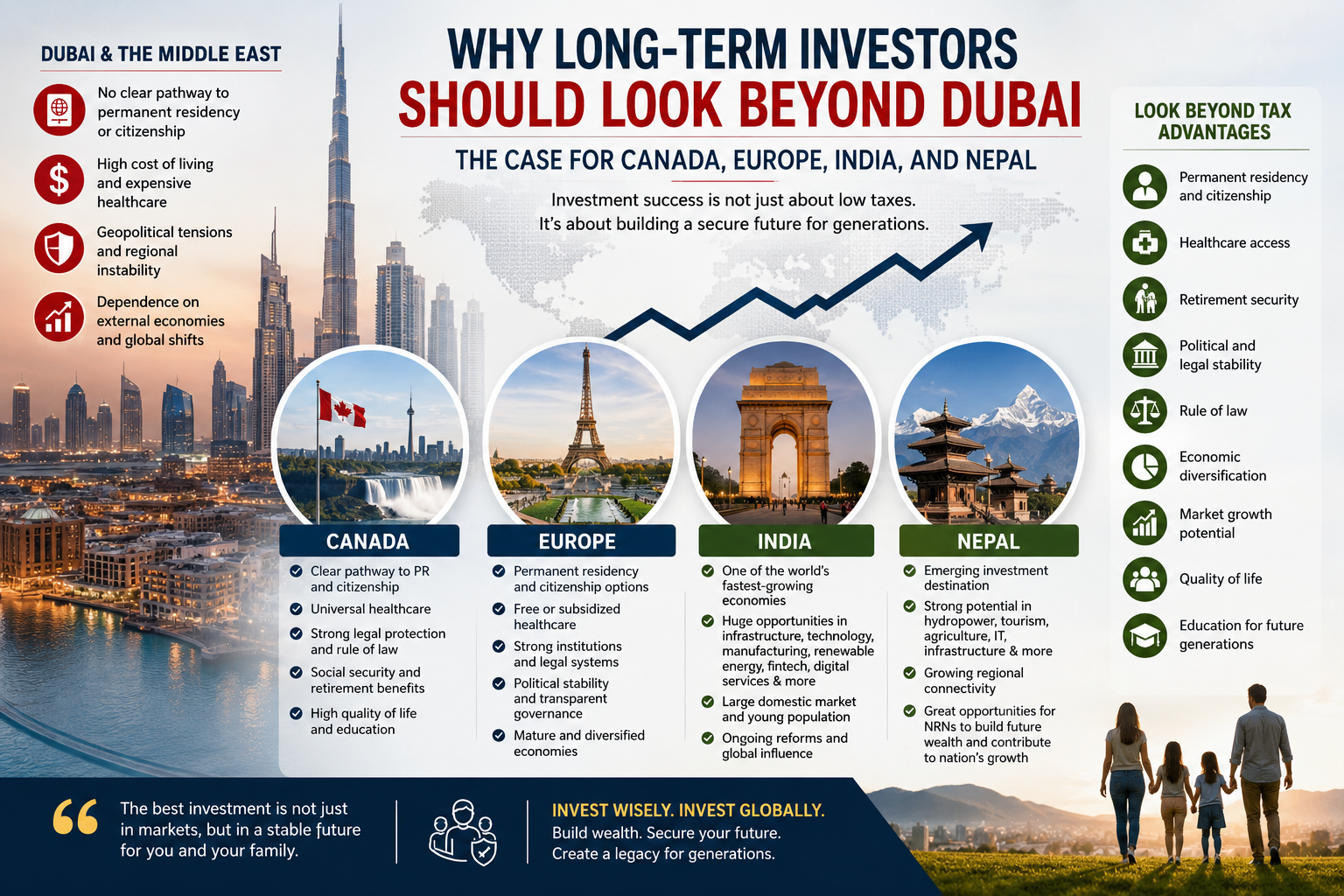
Why Long-Term Investors Should Look Beyond Dubai: The Case for Canada, Europe, India, and Nepal
Jul, 04, 2026
Unitedforum

Upcoming events
Past events

EVENT
IMEX Frankfurt 2026
IMEX Frankfurt 2026: IMEX Frankfurt is the premier annual gathering for the global meetings, events, and incentive trave...

EVENT
HR Tech Europe - HR Executive Event
HR Tech Europe is the region’s leading event dedicated to HR innovation and technology, bringing together senior HR lead...

EVENT
World Ocean Summit & Expo
World Ocean Summit & Expo 2026, organized by Economist Impact, will take place from Wednesday, March 4 to Thursday, Marc...

EVENT
Korea MICE Expo 2025
KOREA MICE EXPO (KME) is South Korea’s flagship event for the Meetings, Incentives, Conferences, and Exhibitions (MICE)...

EVENT
Franchise-Meet Europe- 2025
Franchise-Meet Europe 2025 is set to take place from July 12 to 14, 2025, at the FYCMA - Trade Fairs and Congress Center...

EVENT
IMEX Frankfurt 2025
IMEX Frankfurt 2025 is set to take place from May 20–22, 2025, at Messe Frankfurt, Germany. As one of the premier global...

EVENT
Global Youth Leadership Summit & Awards 2025
The Global Youth Leadership Summit & Awards 2024 is set to take place on 21-22 April, 2025, in the vibrant city of Malag...

EVENT
Agricultural Excellence Conference (AgEx 2024)
AgEx 2024, held November 19-21 in Abbotsford, BC, is Canada’s only national event dedicated to farm management and safet...


EVENT
Korea MICE Expo (KME) 2024
The Korea MICE Expo (KME) 2024 will be held from November 6-8 at Songdo ConvensiA in Incheon, South Korea. As the countr...

EVENT
IMEX AMERICA
IMEX America 2024 is set to be one of the largest gatherings for the global meetings, incentives, conferences, and event...
